Your requests are being managed by memory.
Requests arrive through WhatsApp, email, a sticky note on someone's monitor. Some get handled immediately. Others disappear. Every lost request is lost revenue. Every repeated answer is paid time. Every “sorry, we missed this” chips away at a reputation you spent years building.
You assumed fixing this meant hiring someone technical, buying enterprise software, or running a project you don't have time for. It doesn't.
Requests that vanish
No confirmation, no owner, no record. Customers follow up. Staff apologise. It happens again.
Costs you · revenueThe same question, again
Pricing, availability, how something works — answered manually, repeatedly, by people who could be doing something more valuable.
Costs you · paid hoursNobody knows who owns what
The person who received it handles it if they can. If they can't — or are on holiday — nobody finds out until the customer asks again.
Costs you · reputationEnterprise tools are overkill
The platforms that solve this are built for dedicated IT teams, six-figure budgets, and 18 months to spare. Most businesses don't qualify.
Costs you · budgetA service layer — built from a description of what you already do.
A service layer is the structure that sits between what your organisation offers and the people who need it. It answers three questions: what do we offer, how do requests reach us, and what happens to them when they do.
Most organisations have never explicitly built one — not through negligence, but because every tool that promised it also demanded a specialist, a budget, and a six-month project. ReQuest inverts that.
Not a minor efficiency gain — a change in who can access structured service management, and at what cost.
Describe your services. ReQuest does the rest.
Three steps from zero to a functioning service layer — no configuration expertise required.
Describe what you do
Upload a process document, paste a service guide, or describe your services in plain language in the AI Builder. No specific format required — use whatever you already have.
AI generates the catalog
In one session the AI Builder extracts your service structure — items, ownership, fulfillment types, service level targets, and the natural-language patterns people use to request each one.
Go live across every channel
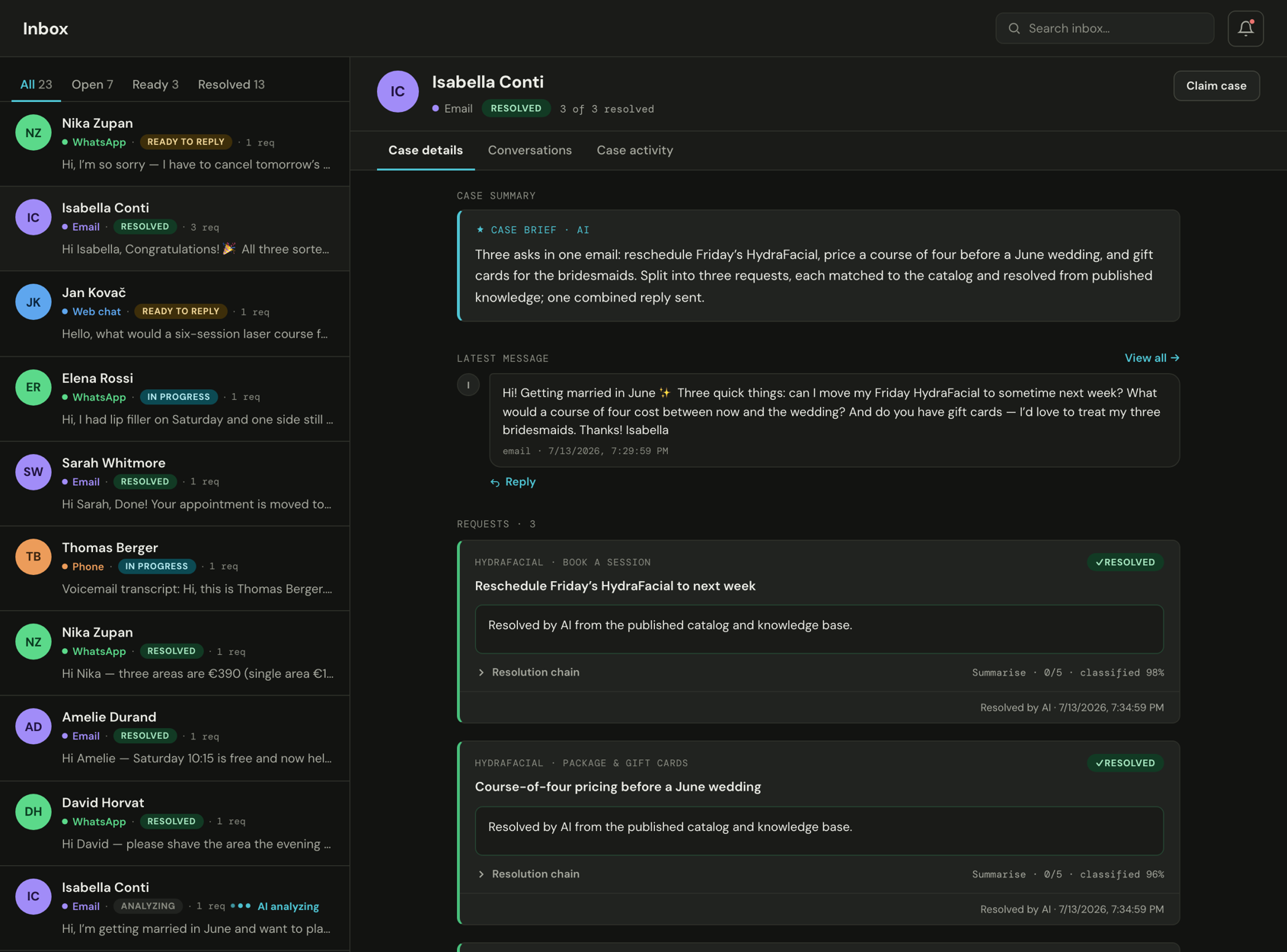
Your portal is live. Requests arrive via web, WhatsApp, chat, or voice. AI classifies each one, matches it to the right service, assigns an owner, and commits to a resolution time — before a human is involved.
An operator platform and a portal — both built by AI.
The interface your team runs the desk from, and the front door your customers reach it through.
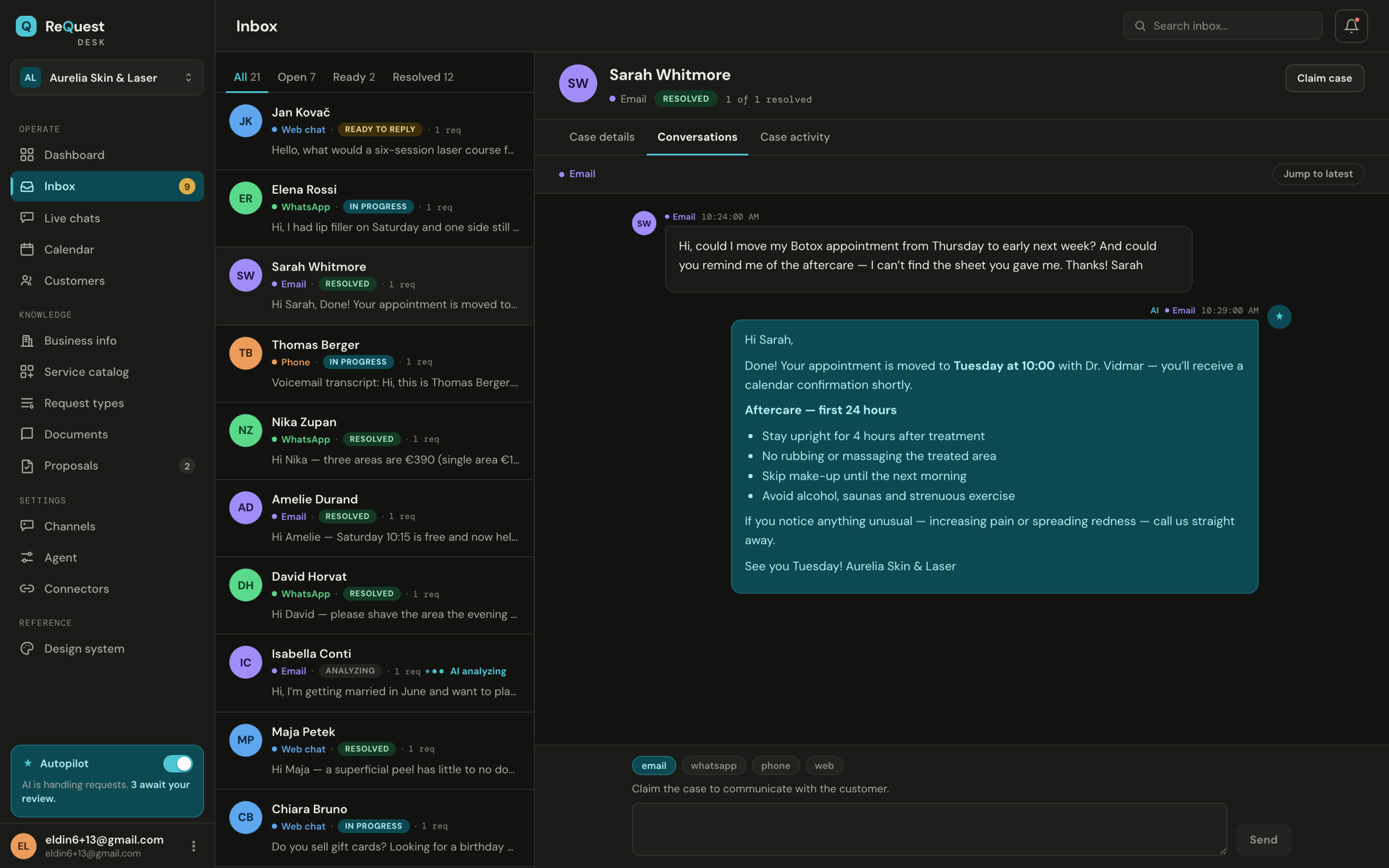
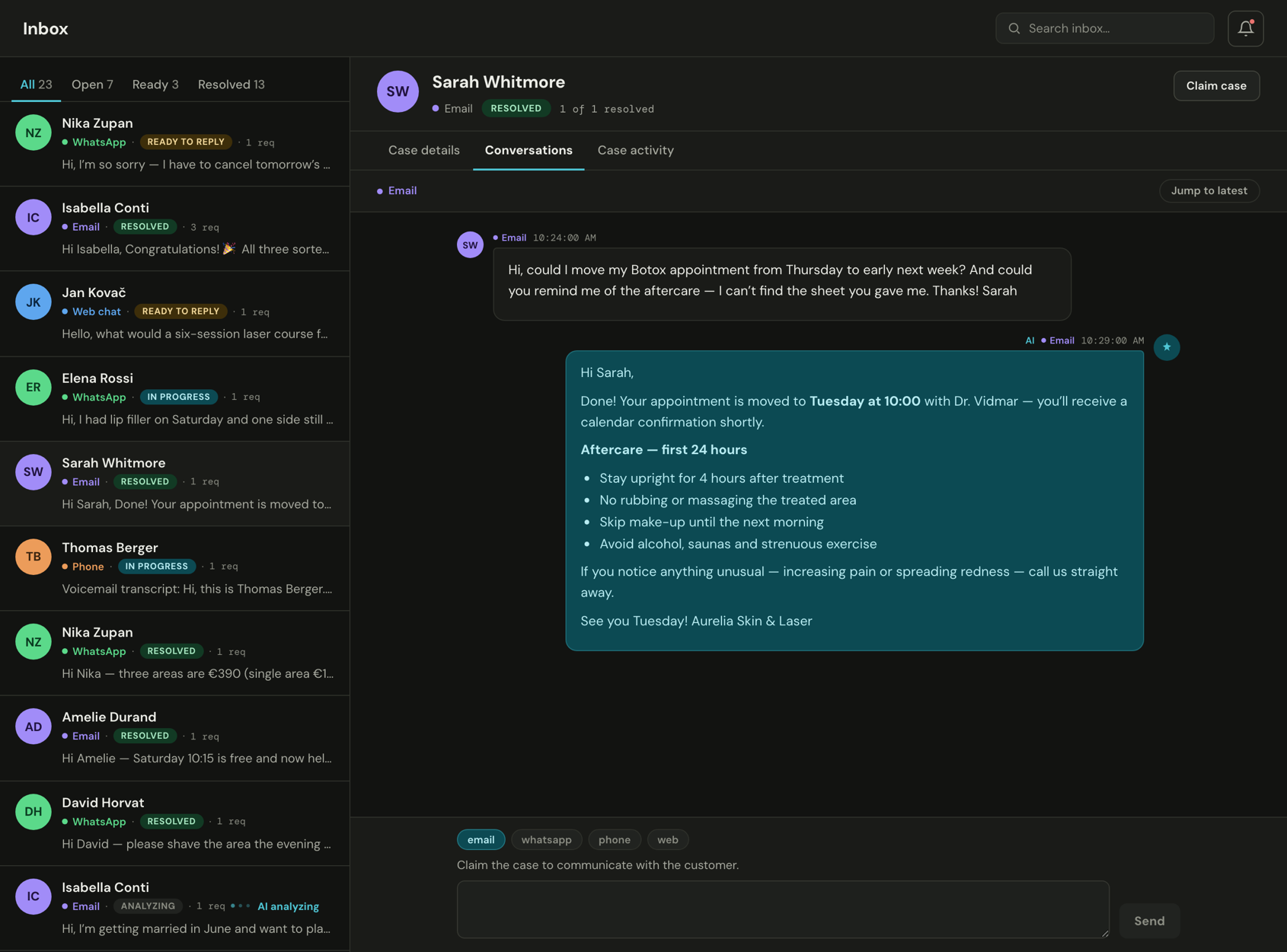
Captured live from a running tenant. A reschedule request answered end-to-end — matched at 98%, replied with published aftercare knowledge, resolved without a human touch.
The catalog builds itself
Point the AI Builder at a document — a process guide, a price list, an operations handbook — or just describe your services. It extracts your full service structure in a single session, then enriches it with the real ways people ask for each thing.
- Two-pass generation: structure first, then the natural-language request patterns that train the classifier
- Services, items, fulfillment types, service level targets and ownership — inferred, not configured
- Regenerate as your services evolve, so the catalog never calcifies
Classified, matched, and answered
Email, chat, WhatsApp and voice all reduce to text and hit the same AI classifier. It matches the request to a service with a confidence score, drafts a grounded reply from your knowledge base, and only asks a human when judgment is genuinely required.
- A confidence score and a committed resolution time on every request
- Replies grounded in your published documents — formatted, not a wall of text
- Full autonomy, human approval, or hard gate — you set the boundary per request type
Hi Steve — you're moved to Tuesday 10:00. A quick recap:
Aftercare — first 24 hours
- Stay upright for 4 hours
- No rubbing the treated area
Kind regards, Front Desk
Every service, with its coverage
A living catalog your team can browse and edit. Each service shows what it is, how it's fulfilled, and how many request types it already answers — so gaps in coverage are obvious at a glance.
- ITIL-aligned service model: functionality, availability, capacity, ownership
- Coverage at a glance — which services can already handle requests, and which can't
- Grouped by category, filterable, generated once and refined forever
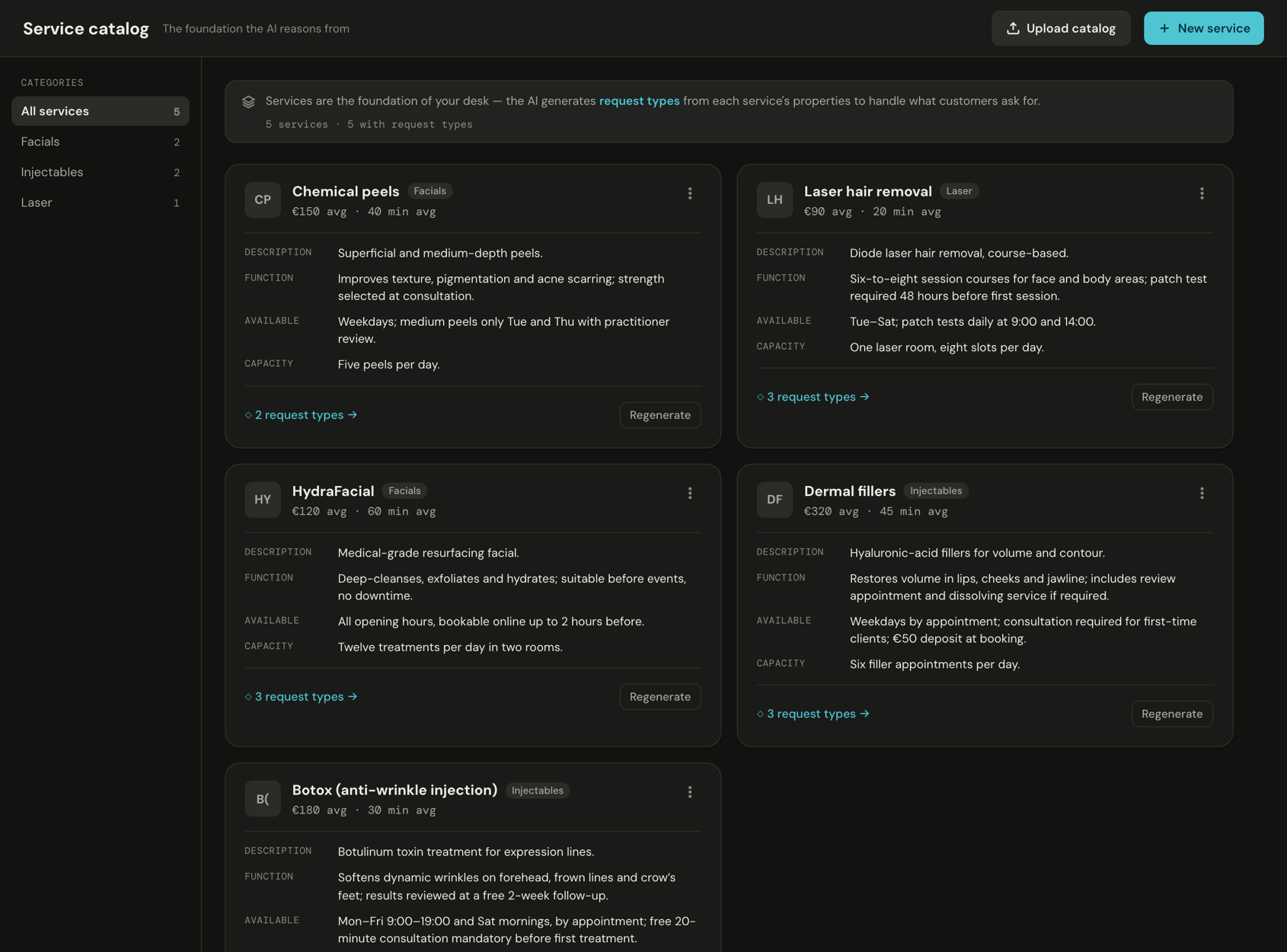
Captured live — generated from one description, coverage on every card.
Ranked by likelihood, split by autonomy
For each service, ReQuest proposes the request types customers actually send — ranked by how often they're the reason for contact, each with a suggested split between what AI can own and where a human steps in.
- Probability ranking so you automate the highest-volume requests first
- Per-step ownership: AI, human, or a human-approval gate
- Publish, tune, or hand a request type full autonomy — on your terms
If people ask you for things, this is for you.
Different industries, same shape: predictable requests eating skilled people's time. Six snapshots of what ReQuest looks like on the ground.
It learns your business like your best hire would.
An answer is only as good as what stands behind it. ReQuest builds a living model of your business — and shows you exactly what it knows, what each document covers, and where the gaps are.
- One description in, a working model out — your services modelled the ITIL way: what each does, when it's available, what it can handle.
- Every document you publish is mapped to the topics it covers — so coverage gaps are visible to you before customers find them.
- Time-boxed amendments — holiday hours, seasonal pricing — apply on schedule and expire on schedule. The knowledge base never quietly goes stale.
- Nothing answers a customer until you publish it. Drafts stay drafts; the AI answers only from approved knowledge.
The part most tools skip — and the reason the answers hold up.
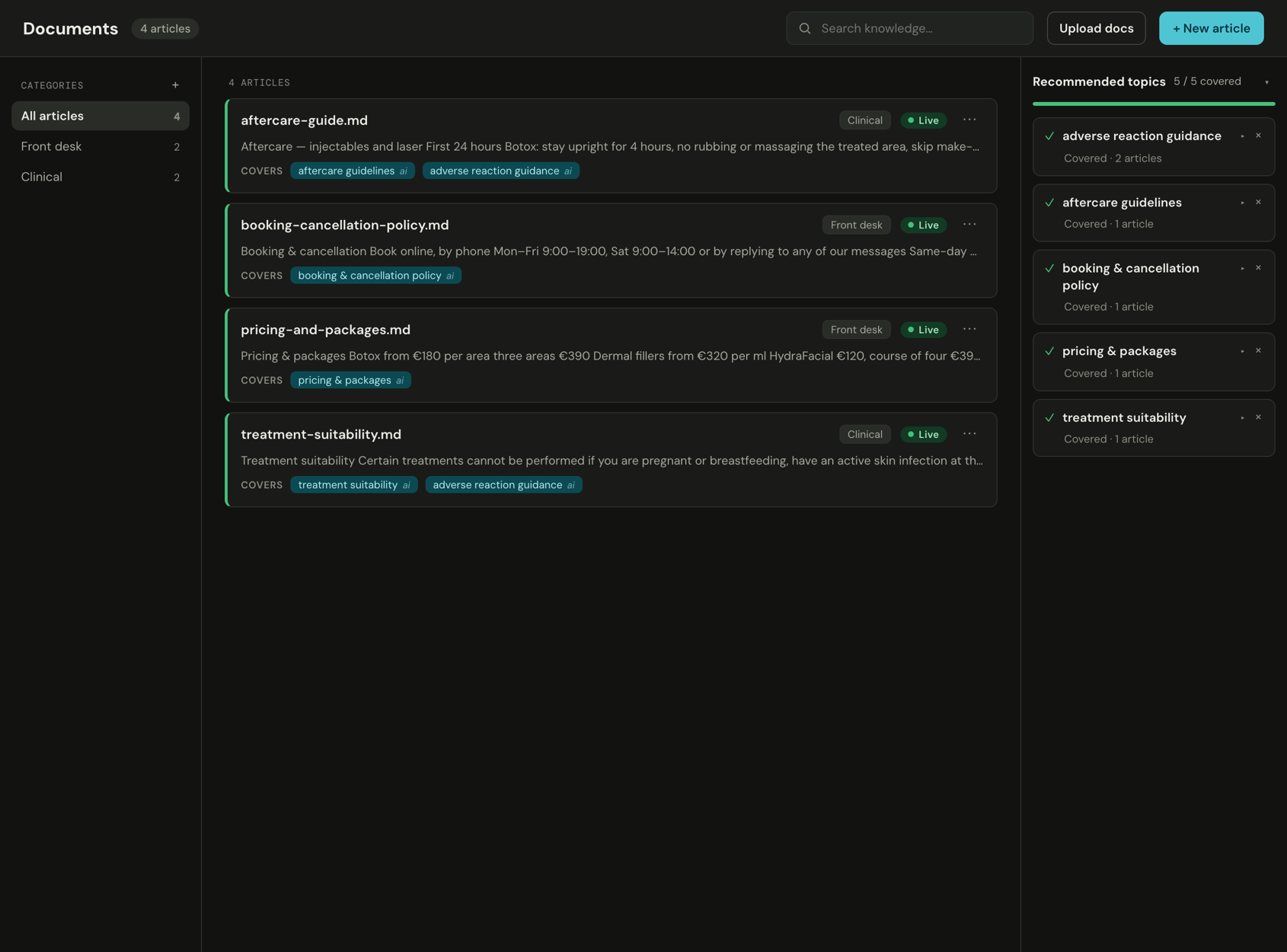
Captured live — each document mapped to the topics it covers; the gaps proposed on the right.
A desk that plugs into your world — and improves itself.
ReQuest isn't a silo. It meets your customers on the channels they already use, operates your systems through connectors and skills, and watches its own performance to propose what to automate next.
Email, chat widget, WhatsApp, web portal and voice — every channel reduces to text and feeds the same classifier. Adding a channel is a setting, not a project.
Calendars, CRMs, billing, ticketing — connectors let the desk act inside the tools you already run, not beside them. Your systems stay the source of truth.
A skill packages how to operate one of your systems or procedures — teach it once, and every request type that needs it can use it.
Appointments, resources and time slots are first-class citizens: the desk offers times, books them, and absorbs the reschedules — the single most common request there is.
ReQuest watches real cases and proposes new request types — and changes to existing ones — based on what your customers actually ask. You approve; coverage grows.
Scoped catalogs per client, brand or business unit — each with its own services, request types and portal. The registry that makes an MSP's client onboarding a step, not a project.
Resolution & governance
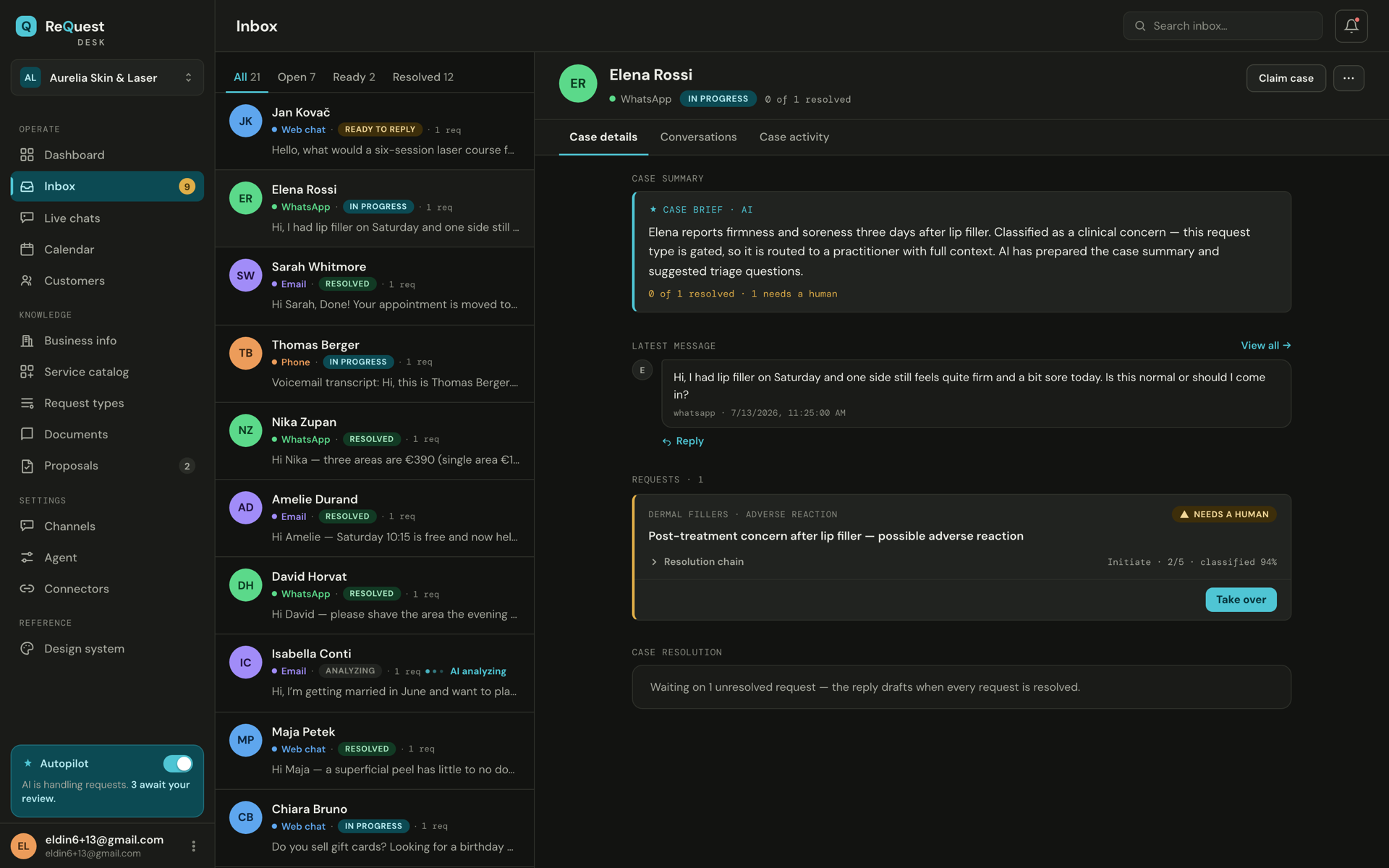
The AI works a case the way you’d insist a person did.
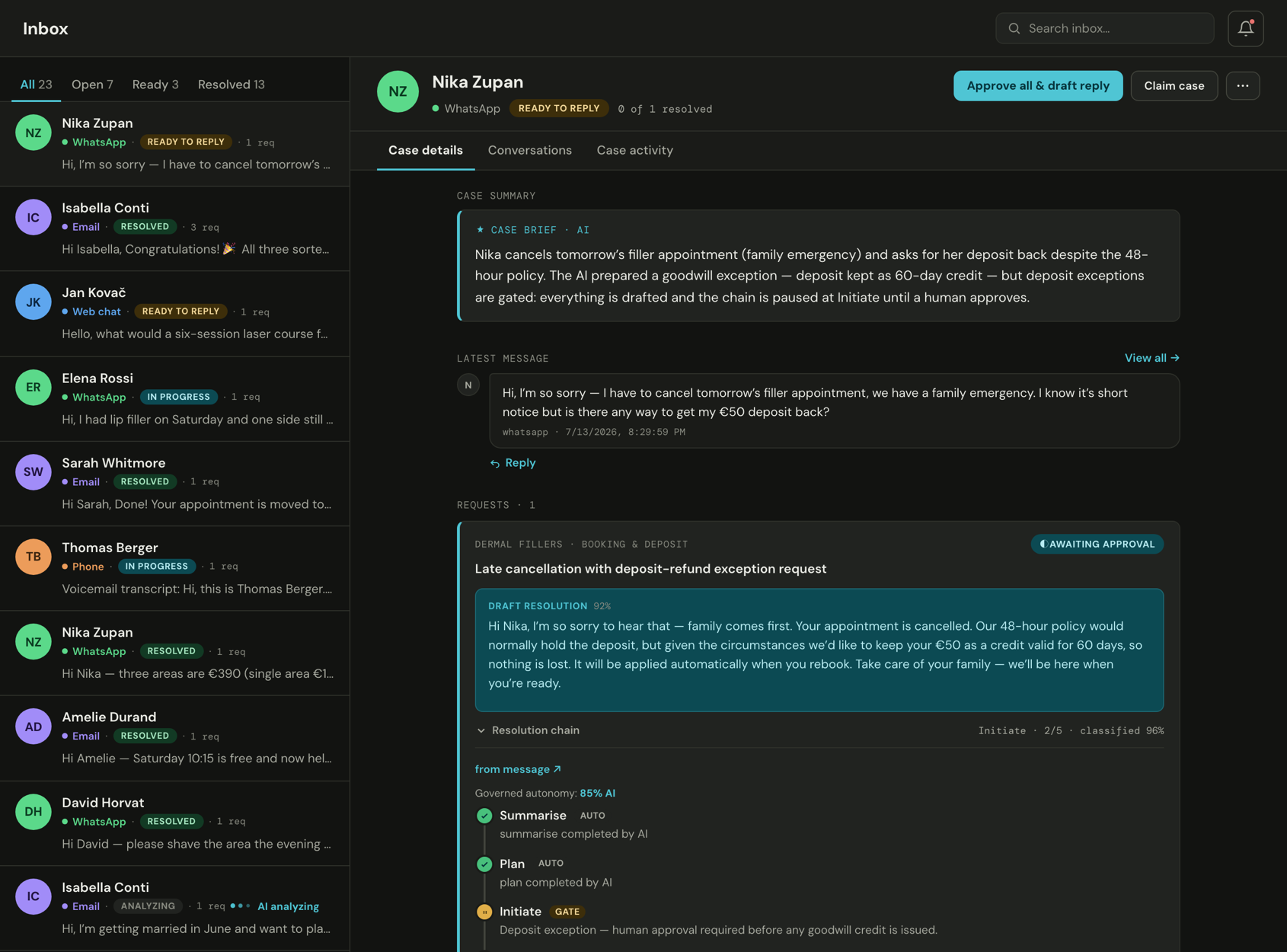
Every request runs the same disciplined, ITIL-style resolution chain. At each step you decide who acts: the AI, a human, or the AI waiting behind an approval gate. Autonomy is granted per request type, per step — and it’s a switch, not a promise.
Per request type, per step. Full autonomy is a switch you turn on — and can turn off again.
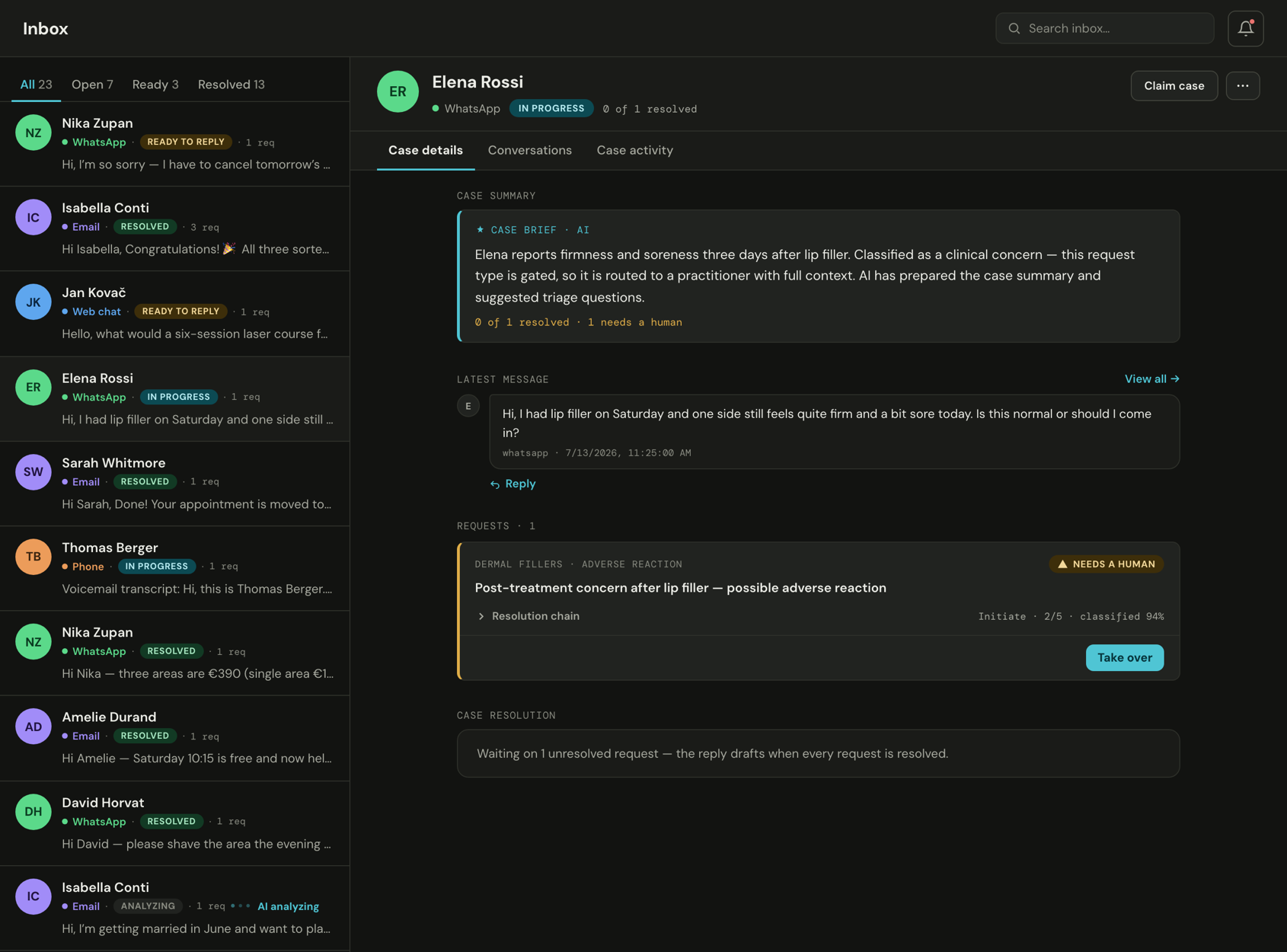
Money, policy, clinical decisions, account changes: the AI drafts, a human approves. A gate cannot be talked around.
Replies come only from your published catalog and knowledge. Outside known patterns, the AI escalates with context instead of improvising.
Matched service, confidence, owner, resolution time — an audit trail managers can actually read.
The activity chain
Every case runs the same eight phases. Who acts at each one is policy — yours.
A routine request with autonomy on runs the full chain without touching your team.
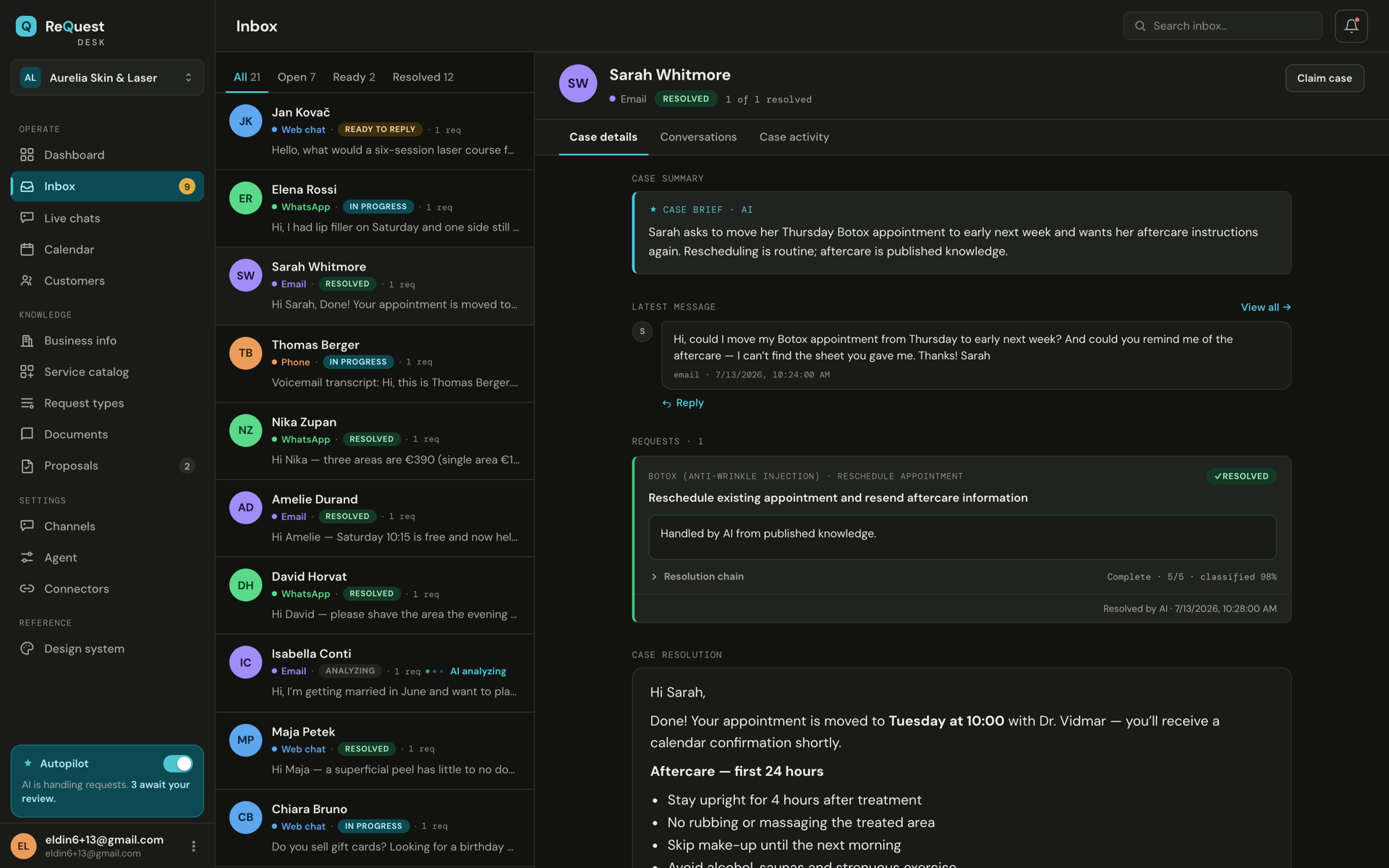
The same live tenant: a routine request classified at 98%, resolved end-to-end and replied — no one touched it.
Not a faster way to configure. A different architecture.
Traditional platforms make you build the catalog. AI-augmented tools bolt a chatbot onto the ticket form. ReQuest is AI-first — the catalog generates itself and classification is the core of the request flow, not an add-on.
Enterprise annual cost, for reference: ServiceNow €80k–€500k+ · Jira SM €10k–€60k · Freshservice €8k–€40k
What early users say.
“We went from handling everything by WhatsApp to having a structured portal in a single afternoon. Our clients noticed the difference before we even told them what changed.”
“As an MSP, the multi-catalog architecture is the thing. I onboarded a new client's full service catalog in one session. That used to take two weeks of back-and-forth.”
The question is not whether your organisation has a service layer problem. The question is whether you have ever had the tools to address it.
— ReQuest whitepaper
Pilot programme open · your story here next.
Priced for access, not for enterprises.
No six-figure licenses. No implementation tax. Start with a pilot and go live in days — then scale as your service layer grows.
Pilot
Prove it on one team
- Guided AI Builder session
- One service catalog & portal
- All channels: email, chat, WhatsApp, voice
- Live in days
Growth
For a growing SMB
- Everything in Pilot
- Unlimited services & request types
- Knowledge base grounding
- Reporting & SLAs
- Priority support
MSP · Multi-catalog
For providers scaling across clients
- Multi-catalog registry
- Per-client branded portals
- One deployment, N clients
- Onboarding as a step, not a project
Transparent, competitive pricing — a fraction of legacy ITSM, with no enterprise contract. Talk to us for a quote.
Everything you're wondering.
Ready to see your service layer live?
One conversation. Your services described. A working catalog and portal — operational before the end of the week.
No commitment · No enterprise contract · Operational in days